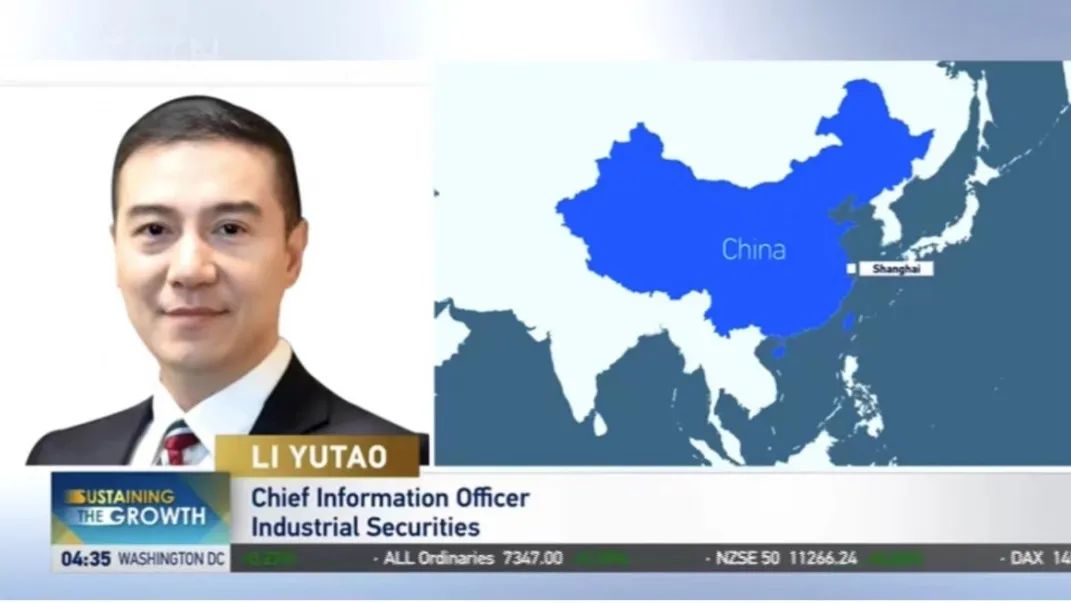
6月8日,公司首席信息官李予涛接受央视CGTN中国国际电视台全球财经频道采访,围绕中国金融业数字化发展及兴业证券数字化转型战略等话题进行了分享。
随着国家“十四五”规划迈入新的征程,中国人民银行、证监会、银保监会先后发布“十四五”科技发展规划及数字化转型指导意见,提出推进数字经济、数字金融、数字货币和金融科技建设,为金融行业的数字化发展提供了指南。兴业证券也在积极探索企业数字化发展道路,于2021年正式发布兴业证券金融科技“十四五”发展规划,核心目标是构建“金融科技生态、财富管理生态、机构服务生态三大生态”和打造“客户服务、风险管理、运营管理和科技管理四项能力”。今年,兴业证券进一步赋予数字化转型核心要义,以“资源整合、边界突破、模式创新、生态建设、平台运营、数据驱动”六个核心要素为驱动方向,规划在财富管理、机构服务、经营管理、运营管理、风险管理和数智基建等六个领域开展数字化转型。李予涛在采访中表示,“如果说我们正在打造一个数字巨人,那么金融科技规划赋予的是骨和肉,数字化赋予的是灵魂,数据赋予的是智慧”。
随着人工智能、区块链、云计算、大数据等技术的逐步成熟,“数智基建”成为兴业证券的金融科技战略重点推动的能力之一。李予涛指出,数字化对兴业证券的技术基础设施提出了新的要求,基础设施需要具备灵活敏捷、可扩展、分布式、安全和弹性,我们为中间层和前端层构建了企业级容器基础设施,支持每天1个亿的服务请求,真正保证了业务解决方案的可扩展性和敏捷性。
李予涛认为,未来数字金融的发展从跨行业的角度将看到互联网金融平台、传统银行、券商等合作建立以客户为中心的生态;随着将信息作为数据资产进行交换的需求不断增长,跨行业数据交换将逐步出现;由区块链等金融科技所支持的监管合作会更加强大。从证券行业内部来看,财富管理业务将继续存在非常分散的市场;机构服务的马太效应将更加剧烈,行业集中度将更高;投资研究、托管服务和风险管理领域的服务外包也将成为趋势。
以下为30分钟采访实录(视频内容为部分剪辑)
1. Q: What do you think about current status of digitization of the finance industry in China? What are the plans for Industrial Securities to empower digit finance with FinTech?
A: China is in the second Year of its 14th 5-year period of economic development,in the strategic plans published by the state council,CSRC,CBIRC,a few key words are most commonly and frequently quoted,such as digital economy,digital finance,virtual currency,FinTech and digitization. So I think we are in the most crucial period of building a strong and healthy foundation for China’s digital finance.
Industrial Securities is part of the securities and futures industry regulated by the CSRC. We are ranked top 10% out of 150 security brokers in China. The securities industry is charged with developing China’s capital markets by providing services in wealth management and direct financing.
In 2021,Industrial Securities has also published its own 5-year strategy,with the goal of becoming a first-class financial services company. Such goal is supported by two growth engines: wealth management and institutional services. In our 5-year strategic plan,the chapters that are related to technology are FinTech strategy and digitization roadmap.
Our FinTech strategy has the objectives of building three ecosystems and improving four capabilities. The 3 ecosystems are in the domains of FinTech,personal wealth management,and institutional services. The four capabilities that we are trying to improve include customer servicing,risk management,operations management,and technology management.
In our digitization roadmap,we are planning to roll out digitization in a total of 6 domains including wealth management,institutional services,corporate management,business operations,risk management,and digitelligence infrastructure.
2. Q: Can you share the latest development and practices of digitization at Industrial Securities?
A: First,I would like to explain the logics behind our digitization roadmap.
Number 1,our digitization roadmap is suitable to ourselves. Top consulting firms and leading financial organizations have published many research papers on digitization that can serve as valuable resources. However we should never simply copy or follow. We need our unique digitization roadmap.
Number 2,we think there is a difference between FinTech strategy and digitization roadmap. Suppose we are building a digital giant,the FinTech plan provides bone and flesh,digitization gives the soul and data provides intelligence.
Number 3,we created a new term called digitelligence,which stands for data-driven digitization. At industrial securities,digitization and digitelligence are interchangeable to each other.
Number 4,our Chief Information Officer serves as both Chief Technology Officer and Chief Digital Officer. In another word,this position is responsible for both technology delivery and digitization of the organization.
Finally,at Industrial Securities,we believe that a successful digitization has 6 core elements including resource consolidation, breaking organizational boundaries,innovation of new business models,building ecosystems,building platform economies, and empowerment with data.
Next I will share two examples on how we digitize our business focusing on those 6 elements.
In our wealth management business,we created a new business unit called the Digitelligence Finance department to focus on serving retail clients. In terms of breaking organizational boundaries,this new department consists of teams coming from wealth management,technology,and customer service center. In terms of empowerment with data,it is utilizing big-data and AI technologies to facilitate the delivery of products and services based on portraits of our customers.
Let me give another example on the digitization of our institutional services that are provided by multiple business units. The key objective is to build a platform that consolidates resources in trading and clearing,product sales,custodian services,investment research,risk hedging,and so on. Also the organizational boundaries disappear as all services are accessible in one single platform.
3. Q: Industrial Securities has built an Enterprise Container Infrastructure using RedHat OpenShift technologies,how does this infrastructure support its digitization?
A: Digitization has set new requirements on our technical infrastructure that needs to be flexible and agile,scalable and distributed,and also secure and resilient.
Digitelligence infrastructure is one of the four capabilities that our FinTech strategy is trying to improve. It has three layers:
The Backbone layer consists of traditional Infrastructure components such as network,servers,storages,clouds,and more importantly a Data Infrastructure that includes data-lakes and data-warehouses. The backbone layer needs to be scalable and robust.
The Middle-layer is the PAAS layer on which our middle tiers and enterprise service bus are deployed. Our middle tiers provide reusable enterprise services,as a result the middle-layer needs to be distributed,scalable and highly-performing.
The Front-end layer is where our client facing applications and business systems are deployed. This layer needs to support applications that are cloud native and micro-serviceable.
With RedHat OpenShift technology,we built an enterprise container infrastructure for our middle-layer and front-end layer. Currently the middle layer supports 100M service calls per day,and truly guarantees scalability and agility of our business solutions.
4. Q: Can you share your views on the trend of future development of digital finance in China?
A: Cross industries,we will see collaborations among internet finance platforms,traditional banks and securities brokers to build customer-centric ecosystems; we will see the emergence of digital asset exchanges as there are growing needs on exchanging information as digital assets; we will also see stronger regulatory collaboration powered by FinTech technologies such as consortium blockchains.
Within the securities industry,we will continue to have a very fragmented marketplace in wealth management business,while for institutional services the Matthew effect will become stronger represented by larger concentration rates; we will also see outsourcing of services in the fields of investment research,custodian services,and risk management,which will gradually transform the industry from standardized to specialized.
Thanks again for this opportunity. We certainly hope that all strategic goals of China’s digital finance are accomplished in the next 4-5 years.